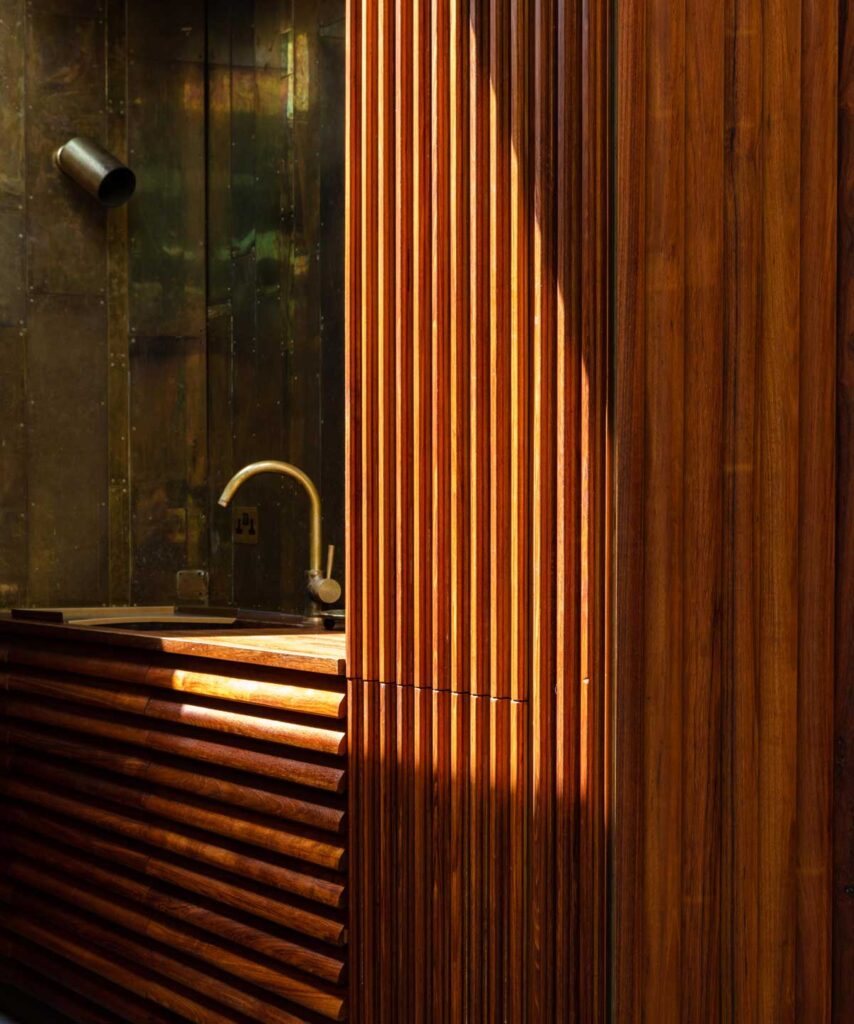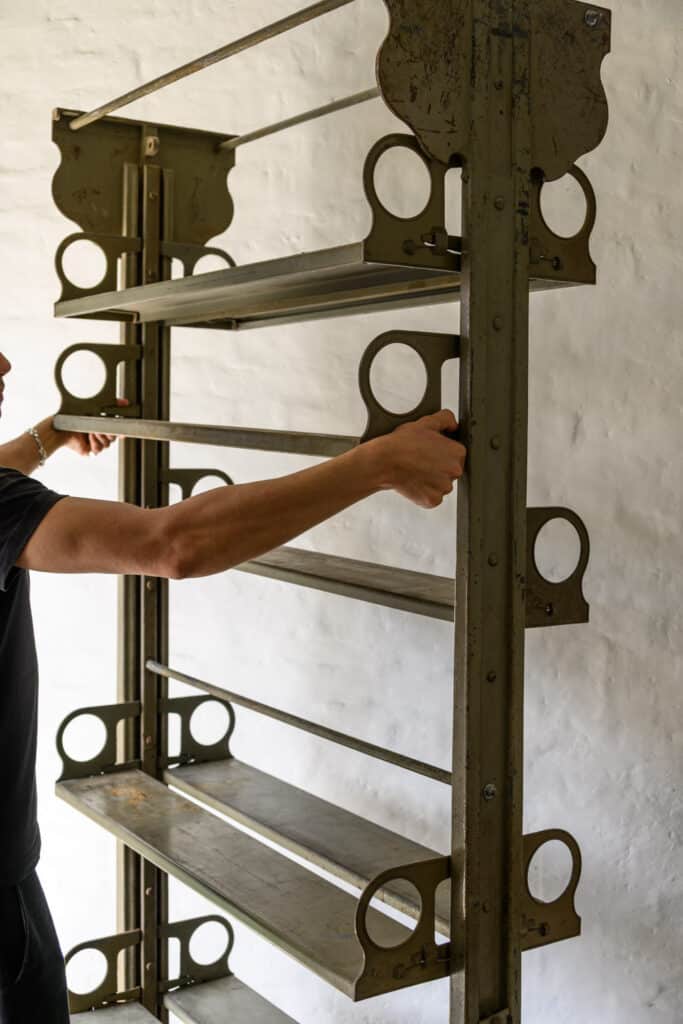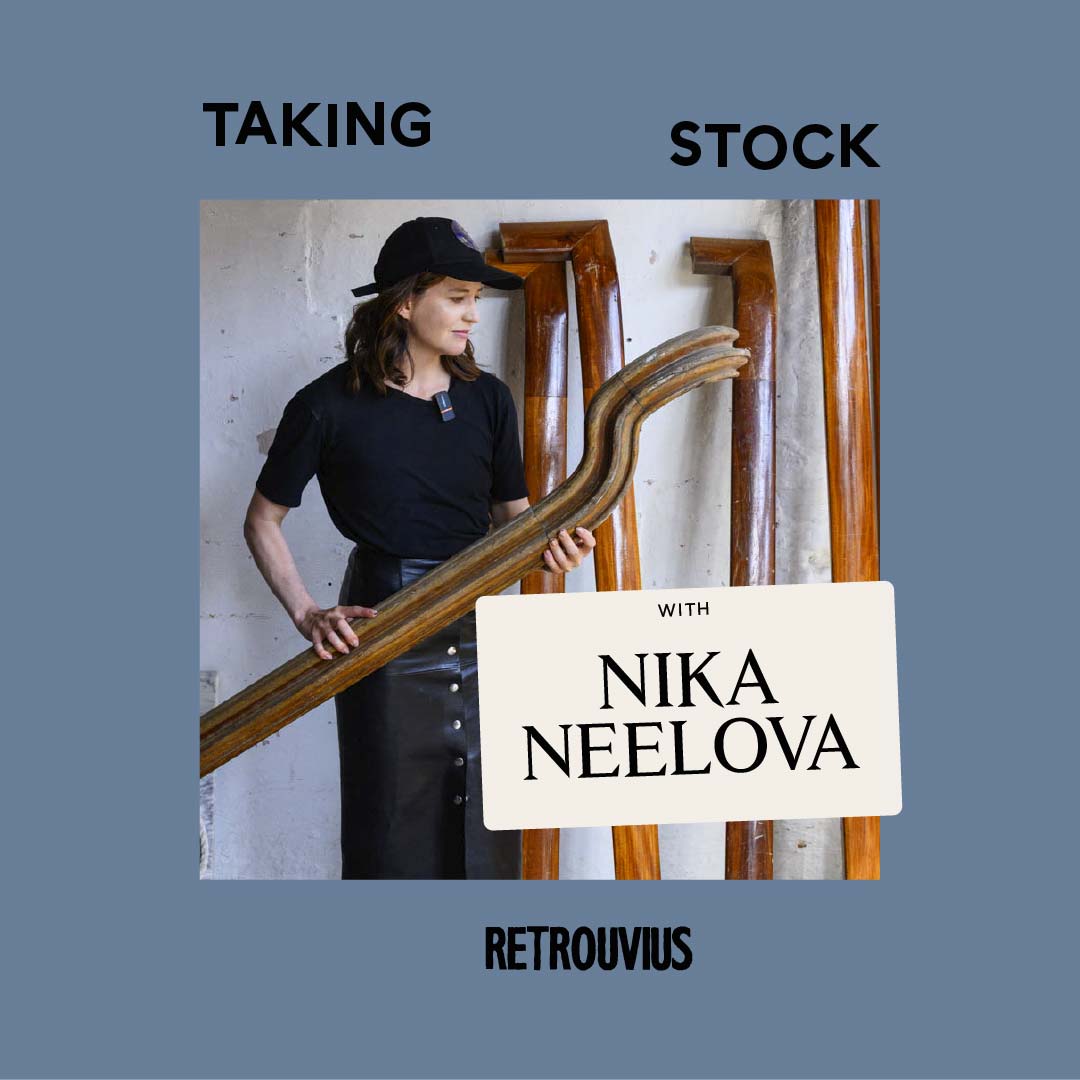
Nika Neelova, UK based Russian artist, joins Adam and I mid heatwave. In this kind of weather, the shop team has naturally migrated downstairs into the cool of the warehouse, where leaning against a slab of marble is the best solution to mitigate the heat. It is photography day here too, and we have just wrapped up shooting a stack of teak handrails that came out of a municipal building in North London; an appropriate setting for an artist whose practice begins where architecture ends, and often with handrails…
Nika transforms salvaged and found materials into sculptures, and throughout the afternoon, our conversation continually returns to time, memory and the strange continuity of things living beyond human time-frames.
What does salvage mean to you?
“In my practice, salvage means tapping into a larger timeframe,” she says. “What I like about these objects is that they carry histories that go beyond our human lifespan. Very often they were created before us and they will outlive us. They exist according to a different calculation of time.”
Neelova continues to explain how she sees these artefacts as vessels and carriers of memory, material, data and of touches and interactions. “When I begin collecting them, I see them connecting different points in history.” Looking around the warehouse, it’s easy to recognise what she means.
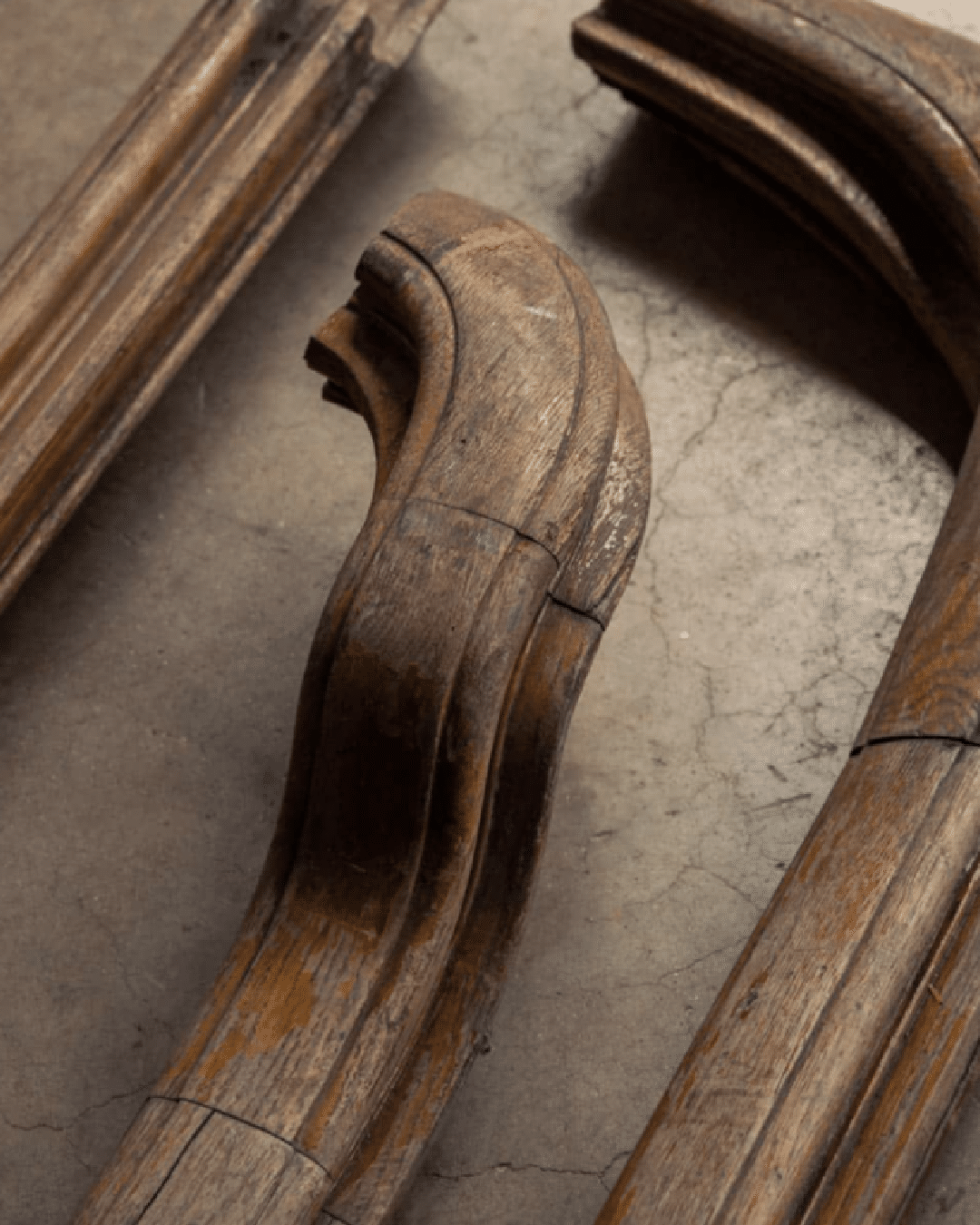
Many of your sculptures incorporate reclaimed stair handrails. What is it about these architectural fragments that draws you to them?
Nika laughs as she recalls dragging an enormous mahogany staircase through south London. “I had absolutely no idea why I bought it,” she says. “It was just instinct.” The staircase sat untouched in her studio for months before revealing its purpose. She continues to explain how each sculpture is constructed from a single staircase, preserving the proportions, curves and character of one specific architectural volume. But the staircase has to be above at least three flights of stairs for the wooden components to mathematically be able to loop around and rejoin itself.
“Each sculpture becomes the portrait of a house,” she gesticulates as she talks. “They’re not monsters assembled from different stairs. They all belong to one place.” Reconfigured into looping forms reminiscent of the infinity symbol, the handrails become meditations on cycles of life, death and
continual return. Designed to fit naturally into the palm of a hand, each rail has spent decades guiding generations of people up and down the same staircase. “I thought it was poetic to work with something made specifically to fit the human hand,” she says. “It was made by hand over a hundred years ago, then spent another century interacting with countless other hands.” She describes the wood as quietly absorbing those encounters.
Turning the handrails over often reveals another layer of history. Hidden beneath the polished surfaces are pencilled numbers, carpenter’s marks and handwritten instructions left by the makers who assembled them generations earlier. “Undoing the joints feels a little like archaeology,” she says. “You’re connecting with the craftspeople who put them together two hundred years ago.”
What makes something worth saving?
Unlike the traditional traits of artists and collectors, Neelova is surprisingly reluctant to own things. “I’m actually very cautious about acquiring objects,” she says. “I don’t really like the idea of ownership in a static sense.” This is fascinating to me, as a self-proclaimed hoarder, instead she describes materials as temporary companions.
“They’re transient agents. They pass through hands and they pass through spaces.” It’s a philosophy that shapes both her studio and her sculptures. Rather than preserving objects unchanged, she prefers to let them continue evolving. “Even with my own work, I don’t tend to save it. I reconfigure it. Everything stays in flux.” For Nika, the objects worth saving are not necessarily the rarest or most beautiful, but those capable of transformation.
“What is worth saving is what can continue to have motion, evolution and change.” She describes her practice as less about creating something entirely new than about weaving together strands that already exist. “I think of my work as cutting into the fabric of the world, undoing some strands and weaving them together into something else. I don’t think anything ever truly begins or ends. Salvage simply allows the lifetime of an object to continue in another direction.”
You’ve described your process as a form of “reverse archaeology”— starting with fragments of buildings and found objects and using them to imagine alternative histories. Can you expand on this concept and explain what this means for you and your practice?
Neelova often describes her process as a form of reverse archaeology. Traditional archaeology uncovers fragments from the past to understand how previous civilisations once lived. Her work moves in the opposite direction.
“I look at our own time as though it’s already in ruin,” she explains. “Through those ruins, I speculate on possible futures. I’m interested in liberating objects from the meanings that human use has imposed upon them. By expanding some of their secondary qualities, they begin to suggest another way of existing.”
Rather than reconstructing history, she reconfigures it. Through our conversation I look around, the warehouse itself begins to feel less like a storage space and more like an archaeological landscape waiting for another future to emerge.
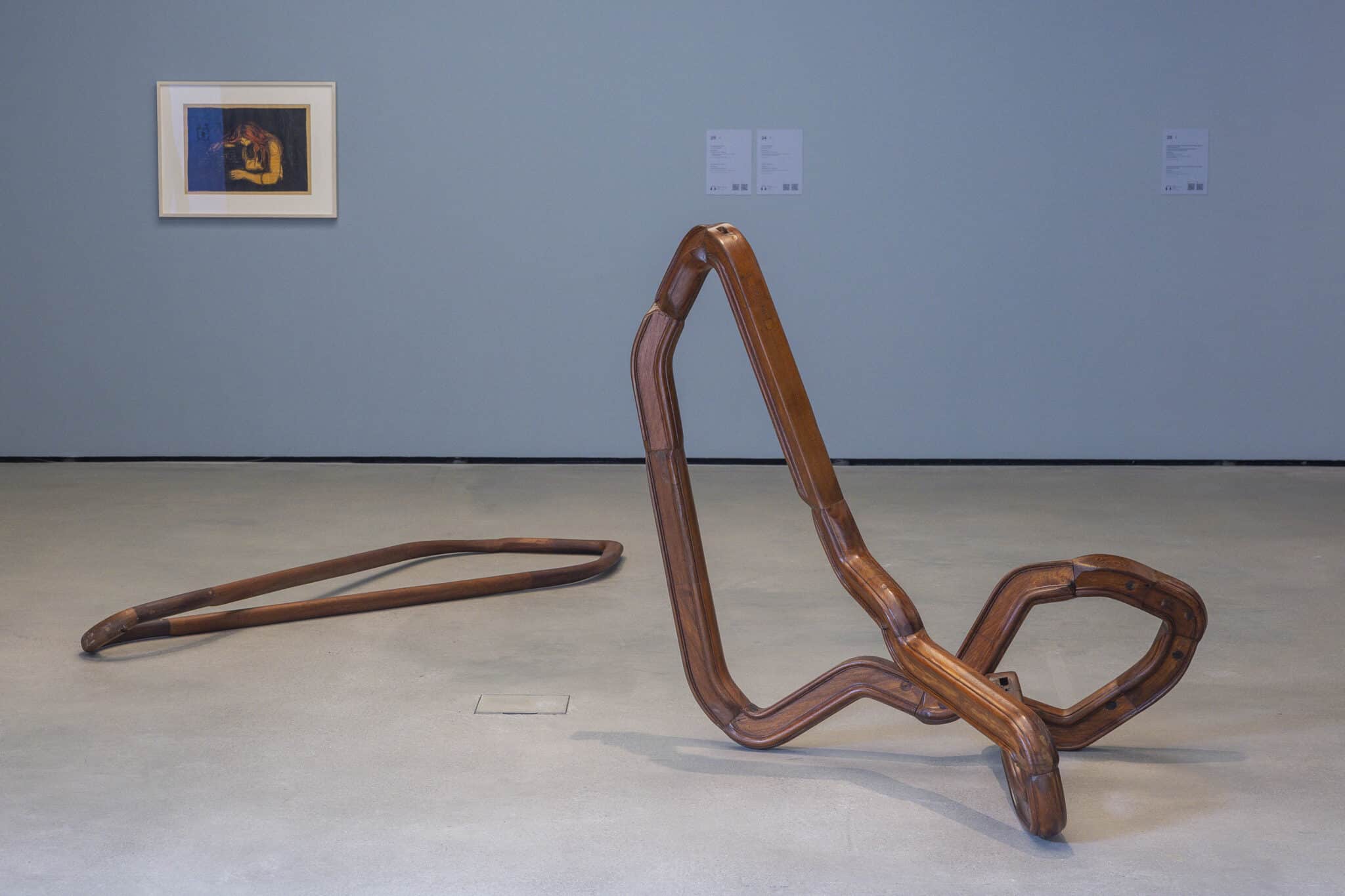
Image: The handrails seen in Nika Neelova’s exhibition Cascade, Museum der Moderne Salzburg, 2025 © Museum der Moderne Salzburg, Photograph courtesy Herbert Rohrer
One of the striking things about your most recent exhibition Cascade in Austria, is the way objects separated by centuries appear to be in conversation with one another. What are the tangible links between these objects, both ancient and newly created?
“Some of the connections are chemical. Some are visual. Others are spiritual or purely intuitive. But each one follows an invisible thread.”
Responding to the city’s history of salt mining, the exhibition brings together archaeological artefacts, historic artworks and newly commissioned sculptures across three interconnected chapters spanning geological time, human history and speculative futures. “I wanted visitors to create their own connections,” she says. “Each object became an anchor point from which invisible lines could emerge.” Researching the genealogies of objects becomes, for Neelova, a way of uncovering relationships that often remain overlooked. “Paying attention to those unseen connections allows you to imagine how things evolve.”
Image: The handrails seen in Nika Neelova’s exhibition Cascade, Museum der Moderne Salzburg, 2025 © Museum der Moderne Salzburg, Photograph courtesy Herbert Rohrer
What do we gain by allowing materials to live more than one life?
We climb up to the top of the three flights of stairs, holding onto salvaged handrails and treading on cheeseboards and iroko. Victorian glass spindles catching Nika’s eye on the way, it lays under a display cabinet. In an age increasingly defined by demolition, extraction and rapid construction, Neelova’s work offers another way of thinking about the built environment. Not as a series of finished objects, but as an ongoing cycle of transformation. As both artist and maker, she is acutely aware of the ethical questions surrounding production.
“We’re already surrounded by more objects than we need, and working with salvage allows the lives of materials to continue rather than beginning again. Every place has its own material history,” she says. “I think it’s important to work with what’s already there.”
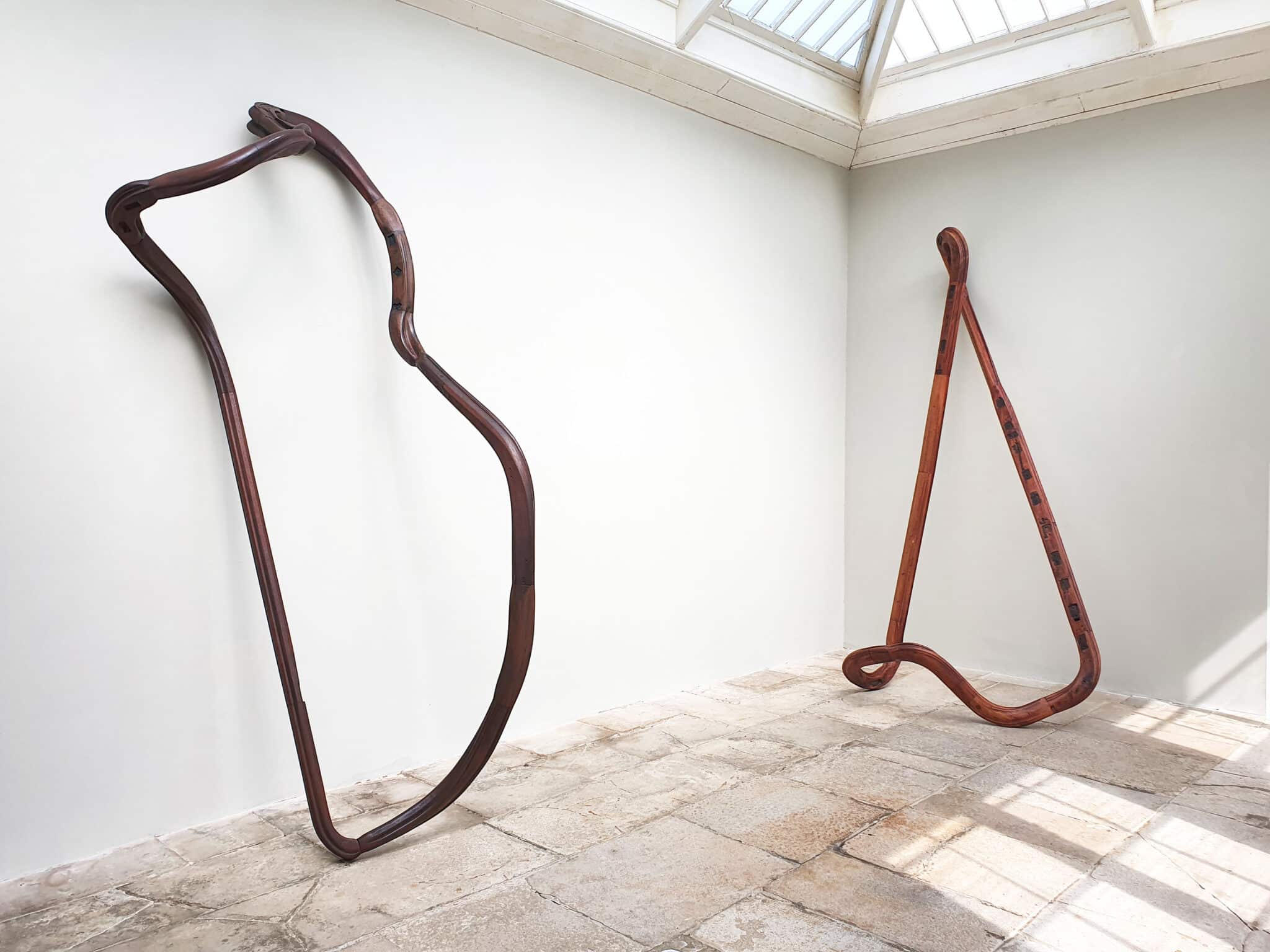
One of Many Fragments, New Art Centre Roche Court , 2021 Photographs courtesy New Art Centre Roche Court
To see Nika’s exeptional sculptures in the flesh, you can visit one of her upcoming exhibitions:
Stay tuned for the next edition of Taking Stock.